What Climate Change Looks Like at 82
Kerala is growing older at the same time it is growing hotter
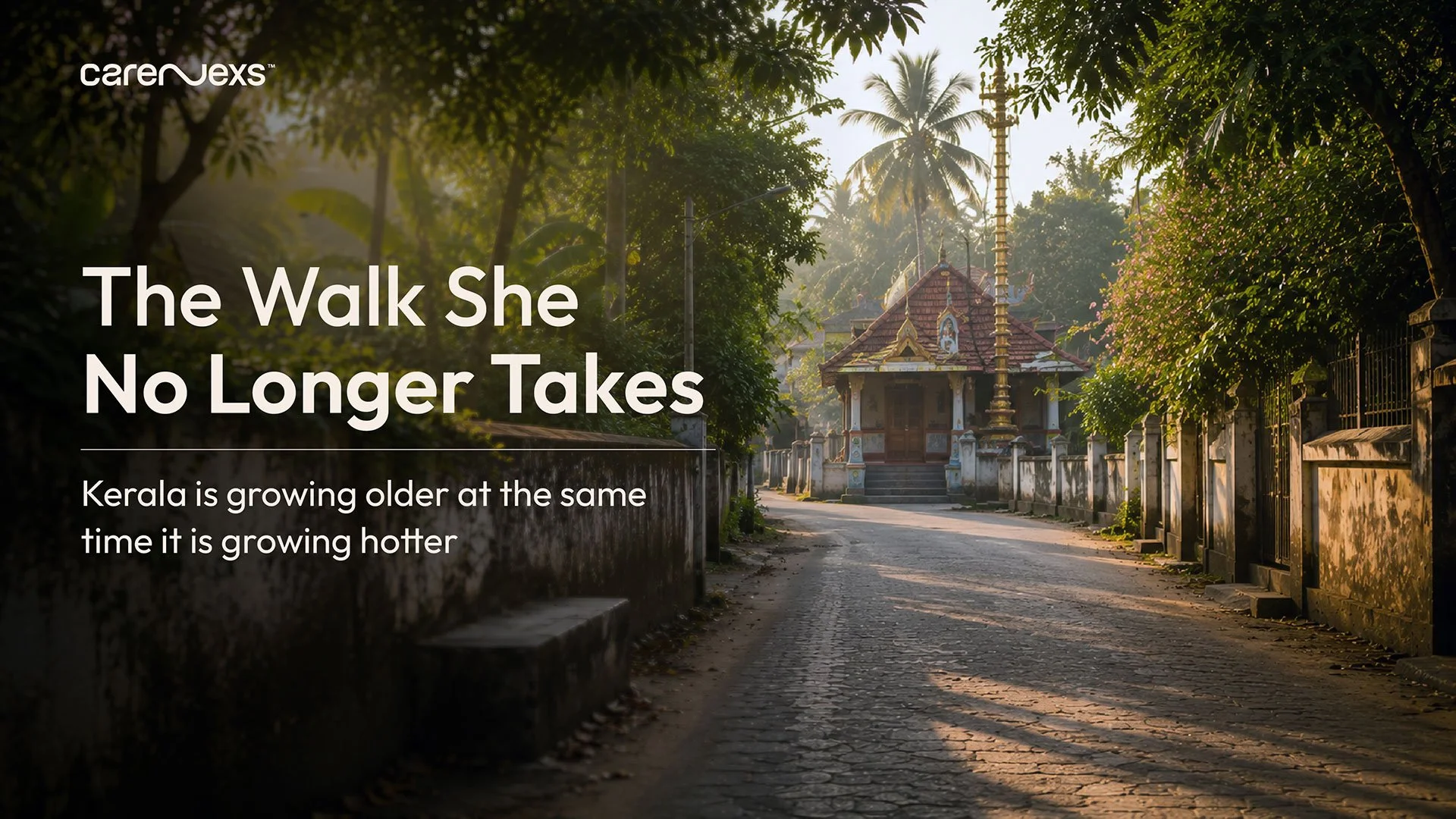
Kamala is 82. She lives alone in Thrissur, in a house her husband built for a big family. The family is gone now. Her son works in Dubai. Her daughter lives in Bengaluru. They call her every week and ask if she is eating well. She always says yes.
Every evening, until last year, Kamala walked to the temple and back. It was not far. Fifteen minutes there, fifteen minutes back. She liked seeing the same faces, the tea shop man, the children coming home from school, the old dog that slept outside the gate.
One evening in April, halfway to the temple, her head began to spin. The road tilted. She sat down on someone's compound wall until it passed, then walked home slowly, frightened. She did not tell her children. She did not want them to worry from so far away.
She has not gone for her evening walk since.
Nobody calls this a climate problem. Kamala herself would never use that word. But it is one.
Her body is 82 years old. It does not handle heat the way it used to. She does not feel thirsty the way she did at fifty, so she forgets to drink water. The afternoons in Thrissur are hotter now than they were when she was raising her children, and they stay hot longer into the evening. Nobody told her any of this. She just knows that going outside no longer feels safe, so she has quietly stopped.
This is happening to thousands of people like Kamala across Kerala right now. Not in some distant future. This year. This summer.
What climate change looks like, up close
We talk about climate change as floods on the news, or glaciers far away, or numbers in a report. For Kamala, it looks like something much smaller and much closer. It looks like deciding not to walk to the temple. It looks like she is drinking less water because the bathroom is up a flight of stairs, and her knees hurt. It looks like sitting indoors through a long, hot afternoon with nobody to talk to.
An older body cannot cool itself as well as a younger one can. It sweats less. It feels thirstylate, sometimes too late. The line between feeling a little unwell and being in real danger is much thinner for someone Kamala's age, and it can be crossed faster than anyone expects, including the person it is happening to.
So when the heat in Kerala climbs higher each year, and stays longer into the evenings, it is older people who pay the highest price. Not because they are weak, but because their bodies were not built to manage this kind of heat, and nobody designed our towns, our health centres, or our daily routines with them in mind.
Kamala would never describe what happened to her as a climate event. She would just say she felt dizzy one evening and decided to stay home after that. That quiet decision, repeated by thousands of older people across Kerala, is what climate change actually looks like for them.
Kerala is growing old, at the same time it is growing hot
Kerala is ageing faster than any other state in India. Soon, nearly one in four people here will be above 60. Many of them, like Kamala, live alone because their children have gone to the Gulf or to other Indian cities for work. The same migration that brought money and comfort to so many Kerala families also left behind a generation of parents ageing quietly, often without anyone close by to notice the small changes.
And Kerala's weather is changing too. The floods of 2018 and 2019 are still remembered by everyone here. The Wayanad landslides of 2024 took over two hundred lives. Summers feel longer and more humid than they used to, and that combination of heat and moisture is especially hard on older hearts and lungs.
These two things, an ageing Kerala and a warming Kerala, are happening at the same time, in the same homes. That is what makes this moment different from anything before it.
It is not only the heat
When the rains come too hard, the problems multiply for someone like Kamala. Roads flood, and the health centre she depends on becomes hard to reach. The power goes out, and if she needed her medicines kept cool, they would spoil. The pharmacy shelves are runningout of the tablets she takes daily for her blood pressure. A few days of this, for someone managing two or three health conditions, can turn into a real emergency.
And there is something else, something we talk about even less. After the 2018 floods, families in Kerala noticed that some of their older relatives, who had been managing fine at home, became confused and lost when they were moved to relief camps. Their familiar rooms, their daily routines, their own kitchen, these things had been quietly holding them steady. Take that away suddenly, and some older minds struggle badly.
Kamala feels a smaller version of this every day now. Her evening walk was never just exercise. It was her time outside the house, her chance to see people, her small piece of the world beyond her four walls. Without it, her days have grown quieter. Nobody would write this down as a health problem. But it is one.
Different parts of Kerala, different dangers
Climate change does not touch every older person in Kerala the same way. Near the coast in places like Alappuzha, old fishermen watch the sea behave strangely, the fish moving further out, the water reaching closer to their homes than it used to. In the hills of Wayanad and Idukki, older people in tribal villages can be cut off completely from any hospital when a landslide takes out the only road in or out. In Palakkad, which gets Kerala's harshest sun, elderly farm workers still go out into the heat because there is no other income to replace it. And in the crowded lanes of Kochi, old residents sit inside small concrete homes that trap the heat, with no garden, no breeze, and nowhere cooler to go.
There is one more danger that surprises people. As forests dry out and shrink, wild animals are moving closer to villages in search of food and water, especially in places like Wayanad. Several of the people hurt or killed in these encounters in recent years have been elderlyresidents, often caught outdoors alone in the early morning. It is a smaller part of this story, but a real one, and a reminder that the changing climate is reaching into older lives from more directions than we usually imagine.
In almost every one of these situations, it is older women who carry the heaviest weight. They live the longest, they are the most likely to be widowed, and they are the most likely to be managing alone.
What families can do, starting today
Most people reading this are not in government. You are someone's son or daughter, or you have an elderly neighbour, or a grandmother like Kamala somewhere in your own family. There is a great deal you can do without waiting for anyone else to act.
Call your parents during a heatwave, not just to ask how they are, but to ask specifically if they are drinking enough water and if their fan is working. Check where their medicines are stored, and whether they would survive a day or two without power. Ask if there is a neighbour who checks on them, and if not, find one and introduce yourself. Keep a small list of emergency numbers near their phone, written large enough for them to read without their glasses. None of this costs much. All of it can matter enormously on the day it is needed.
What Kerala should do
Beyond families, there is work for our health system and our government too, and it does not need to be complicated.
Local bodies, including Kudumbashree networks that already reach almost every neighbourhood, could maintain a simple list of older residents who live alone, so that someone can check on them when a heatwave or flood warning is issued. Health centres could ask one extra question before any older patient goes home from hospital: do you have water, a working fan, and someone nearby who will look in on you? And the state could start counting how many older people are admitted to the hospital or die during heatwaves and floods, because right now, almost nobody is counting, and what is not counted is easy to ignore.
Kerala has just set up a new Senior Citizens Welfare Commission. It is a real opportunity. But it will only matter if climate risk is part of its work from the very beginning, not added later as an afterthought.
Kamala is not asking for charity
Kamala does not think of herself as vulnerable. She raised two children, ran a household, and survived things far harder than a hot afternoon. What she has lost is not her strength. It is a system around her that even noticed she had stopped walking and asked why.
Kamala is not a real name, but her story reflects the lived experience of thousands of older people across Kerala today. Background data and sources are drawn from the WHO Heat and Health Fact Sheet (2024), the Lancet Countdown 2023, the HelpAge India Climate Resilient Ageing Report (June 2026), and the Kerala State Planning Board Economic Review