She Knew Where Everything Was. Then the Water Came.
What happens to an older woman's memory when a flood moves her from the home that held it together.
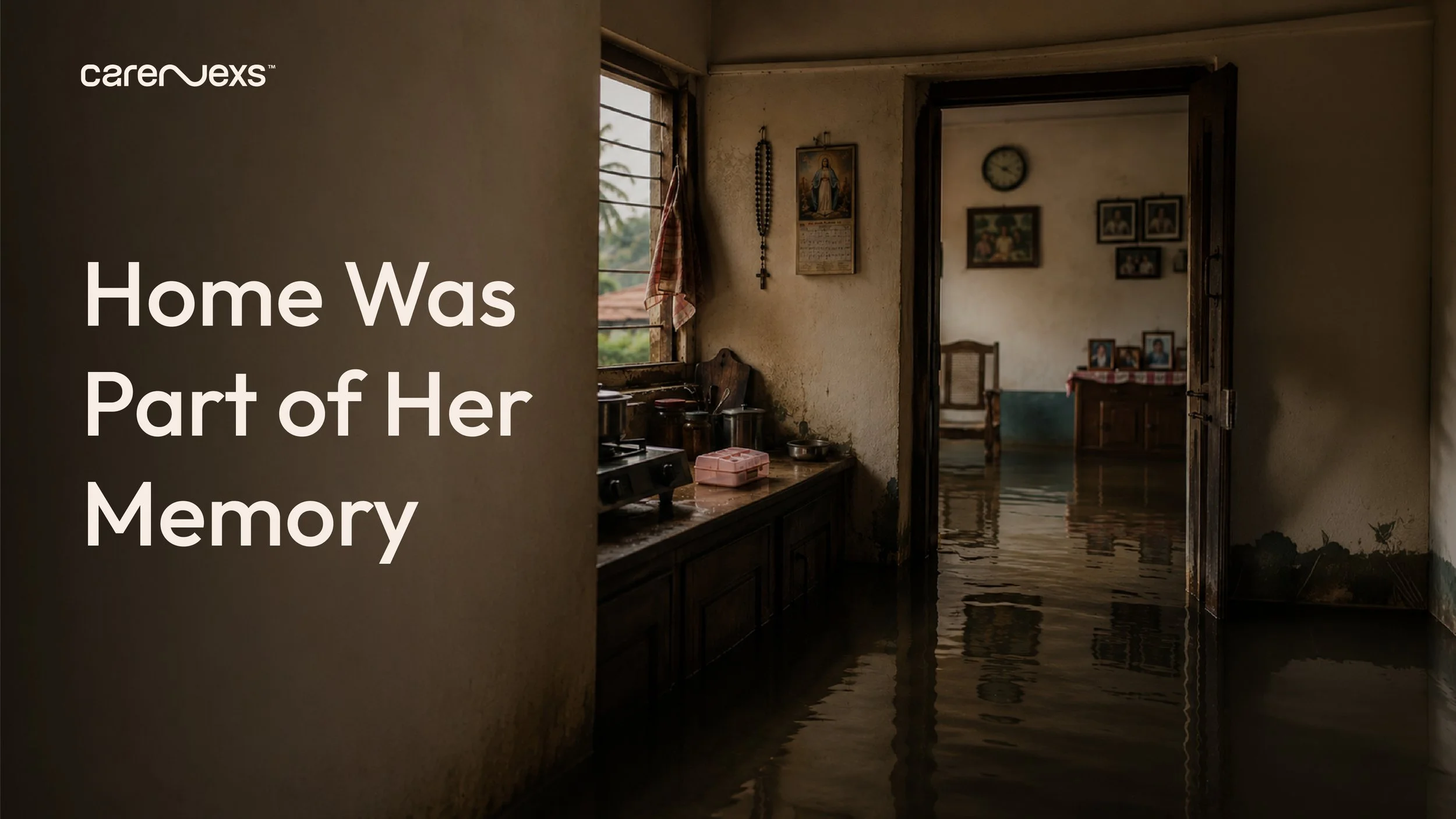
It was past midnight in the relief camp when her daughter found her.
Mariamma, seventy-eight years old, was standing near the entrance of the school hall they had been sheltering in for nine days. She was not distressed, not crying. She was simply standing, looking at the rows of mats and sleeping bodies, quietly confused about which direction was the kitchen.
There was no kitchen. There was no direction. The hall looked the same from every side.
Her daughter, Rosily, took her gently back to their mat. She told her that everything was fine, that they would go home soon. Mariamma nodded and lay down. But Rosily noticed something she had not noticed before. Her mother did not ask where she was. She did not ask what had happened to the house. She simply lay down, in the way that a person lies down when they have accepted that nothing around them is recognisable anymore.
We usually count rescued lives, rebuilt houses, and distributed rations. We rarely count the minds that became more fragile after the rescue.Before the rains came, Mariamma had managed perfectly well.
She woke every morning at five-thirty, made tea, and kept her small pink pill box on the left side of the stove so she would never forget it. She knew the sound of the neighbour's gate, which told her it was seven o'clock. She knew that the TV rosary programme came on at two in the afternoon, and she always watched it from the same chair, in the same corner, with her own rosary in her hands. Her day was a map, and she moved through it without difficulty.
The family had noticed small signs over the past year. She sometimes repeated a question she had asked ten minutes earlier. She occasionally forgot a name she had known for decades. But at home, in the house she had lived in for forty years, these moments were minor and infrequent. She was oriented. She was herself.
Then the water rose in three hours.
The evacuation was right. The alternative was worse. Nobody is questioning that.
But what the family did not know, and what nobody at the camp told them, is that for an older person whose memory is already becoming fragile, the loss of a familiar home can do something that flooding itself does not. It removes the external scaffolding the mind has been quietly leaning on.
The kitchen that told her where the pills were. The window that showed her which way was east. That gate sound telling her it was seven o'clock. These are not just objects and sounds to a person whose memory has begun to soften. They are part of how she thinks. Take them away, and her internal map does not find another route. It simply becomes less sure, more confused, more afraid.
Our minds and our surroundings work together. Home is not simply where an older person lives. It becomes part of how they stay oriented in the world. When that environment disappears overnight, the mind carries the cost.
She had not simply lost a house. She had lost the external structure that was doing memory work she could no longer do entirely on her own.
Mariamma's experience is deeply personal. It is also remarkably common. Researchers who followed older survivors of the 2011 Japan earthquake and tsunami found that housing loss was significantly associated with cognitive decline, and remained so six years later. The mechanisms were depression and the loss of social connections. Disaster camps, as they are currently run, tend to make both worse.
Kerala's own data points in the same direction. A community study after the 2018 floods found that 48% of flood-affected people showed symptoms of depression, highest in the oldest age group. A year later, the Idukki District Mental Health Programme recorded a 25% rise in patients, with doctors directly linking it to flood-related distress.
Mariamma is not only representative because she is older. She is representative because she is a woman. In most of the families I have worked with over the years, the older person who becomes disoriented in a relief camp, the one who wanders at night, the one who sits quietly in the corner and does not tell anyone she is struggling, is almost always a woman.
This is not coincidence. Older women in Kerala live longer, are more likely to be widowed, and are more likely to be living alone. The 2011 Census data shows that by age eighty, approximately 84% of women in Kerala are widowed, compared to around 17% of men.Older women often know where everything is. The rice container. The prayer book. The medicines. The neighbour. The grandchildren's routines. Their relationship with home is often deeper than men's. Many of them have spent entire lifetimes managing households, caring for children and grandchildren, holding the daily routines of the family together. Therefore displacement may remove a larger part of their daily cognitive world.
In a camp, an older woman, like Mariamma, who is confused may be seen as difficult, as demanding, as someone who is simply not adjusting. The family is overwhelmed. The volunteers are doing their best with impossible logistics. Nobody has the language for what is actually happening, which is that a woman whose memory was already becoming fragile has lost the architecture that kept her functioning.
When Mariamma cannot find the toilet, it is not stubbornness. When she asks for her husband who has been dead for twelve years, it is not performance. She is searching for something familiar. She is not going mad. She is disoriented. There is a significant difference, and recognising it is the beginning of helping her.
The camp eventually closes. Families move to temporary housing, or return to damaged homes, or, as with so many Wayanad landslide survivors, are resettled in new government housing far from the land they knew. For Mariamma, a rebuilt house in a different neighbourhood is not a return. It is another displacement. The house may be structurally sound. But the gate is on the wrong side, the light comes in from a different direction, the neighbour's voice is unknown, the prayer corner does not exist yet.
Research on Japan's disaster survivors found that the harm did not end with the camp. Cognitive decline continued during the resettlement phase. For some, it accelerated. The mind was still looking for the home it had lost.
Disaster recovery is often measured by houses built and roads reopened. But for some older people, the hardest recovery is the one nobody is measuring.
None of these changes are particularly expensive. Many are simply changes in how we notice and respond.
Relief camps already have checklists for food, water and sanitation. Perhaps they also need a checklist for memory. Notice older adults who seem lost, wander, or cannot say where they came from. Keep them with family members or at least one person they recognise. Reduce unnecessary transfers between locations. Every additional move removes what little orientation they have found.
If a parent becomes more confused or withdrawn in the camp, do not put it down to old age or the shock of the flood alone. Notice it. Mention it to a health worker. And keep following up after they leave the camp, because the hardest period is often not the flood itself but the weeks of moving that come after.
Kerala's disaster system can go further. Every relief camp should note, at the point of registration, whether an older person is showing signs of confusion or memory difficulty. ASHA workers should visit elderly flood survivors in the weeks after they leave the camp. And when it comes to resettlement, keeping neighbours together is not a sentimental idea. A known face across the corridor does something real for an older person's mind that no formal intervention can fully replace.
Rosily sat with her mother for a long time that night in the camp.
She told me later that what stayed with her was not the confusion. It was the silence. Mariamma had always had something to say, a story for every occasion, a memory that reached back decades and made sense of whatever was happening now. That night there was nothing. She lay there quietly in a way she had never been quiet before.
Rosily did not have a word for it then. She does not need one. That night, she understood something our disaster response systems are only beginning to recognise: when you move an older person from the home that has been doing their remembering with them, you are not just moving a person. You are moving something much harder to rebuild.
Mariamma and Rosily are composite characters from documented evidence in Kerala. The story is not one family's account but a reflection of patterns observed across many families after the 2018 and 2019 Kerala floods and the 2024 Wayanad landslides.