Designing an Ageing Society: A Call to Social Work in Kerala
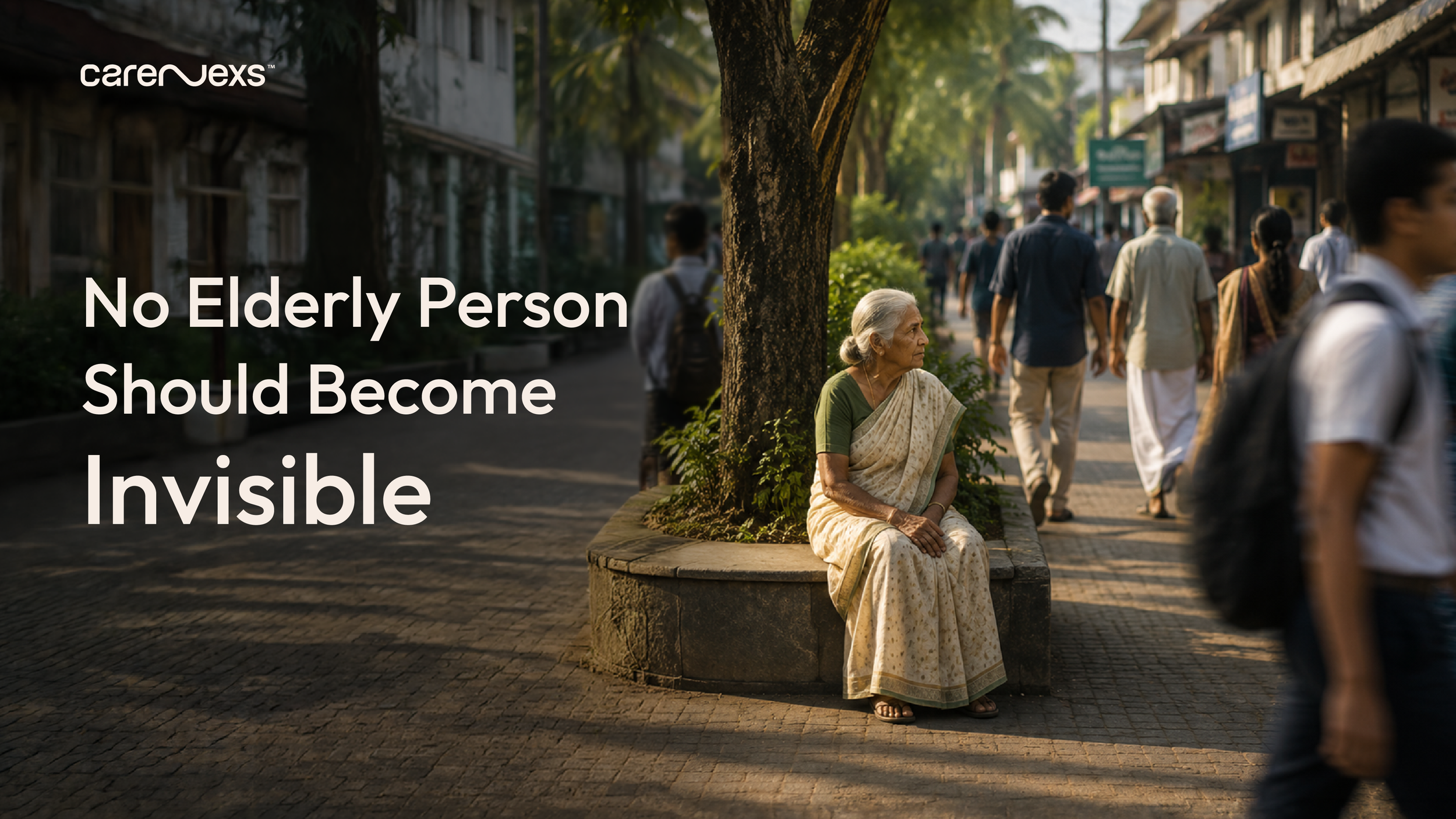
Over the years, I have sat with elderly men and women in their homes across different countries. Villages, city apartments, situations that looked fine on the surface and were quietly collapsing inside. What stays with me is not poverty or illness. It is invisibility. People who held families together for decades are now sitting alone at noon with nowhere to be and no one expecting them.
I have worked in places recovering from disasters, conflict, and public health crises, and organising networks of elderly groups. Across all of it, one pattern holds. When society shifts, professions either move with it or become less relevant. Kerala is in the middle of a shift right now, and social work has a genuine choice to make.
Kerala has done this before. Building a public health system, running literacy campaigns, making local self-governance into something real rather than a paper exercise and managing a progressive palliative care programme. None of those were comfortable. They required sustained professional effort and a willingness to work differently. The ageing transition is the next version of that challenge, and I argue that social work is the profession most naturally placed to lead it.
The state has passed the 2025 Elderly Commission Act and has now set up a Department of Senior Citizens Welfare. Real steps. But the human infrastructure to make those structures work for actual elderly people in actual homes does not yet exist. I want to be honest with colleagues in social work colleges and professional bodies about why we are not ready, and what getting ready would actually take.
This is not a healthcare problem
When most people in India talk about ageing, they reach for a medical frame. More geriatricians, more hospital beds, more home nurses. That frame is not entirely wrong. But it misses most of what is actually happening.
The Longitudinal Ageing Study in India, or LASI, the country's largest survey of older adults conducted in 2017-18 by the International Institute for Population Sciences, puts Kerala's situation in sharp relief. Among elderly people aged 60 and above, Kerala has the highest multi-morbidity rate of any Indian state, at 52%. More than half of Kerala's elderly are managing two or more chronic conditions at the same time. And 57% have been diagnosed with cardiovascular disease, again the highest in the country. A separate study using the same LASI data found that around 30% of elderly women in Kerala show symptoms of depression. These numbers do not make the case for more doctors alone. A person managing diabetes, hypertension, and loneliness simultaneously needs medical care and social support. The two cannot be separated.
Social work programmes in India were built for a different era. Poverty reduction, welfare delivery, NGO administration, and institutional care. Those needs have not gone away. But we are watching a demographic shift that will touch almost every part of society, and our programmes have not caught up with it.
Families are different now. Who is present and who is absent in a household has changed in ways that were not true a generation ago. Kerala is a particular case.
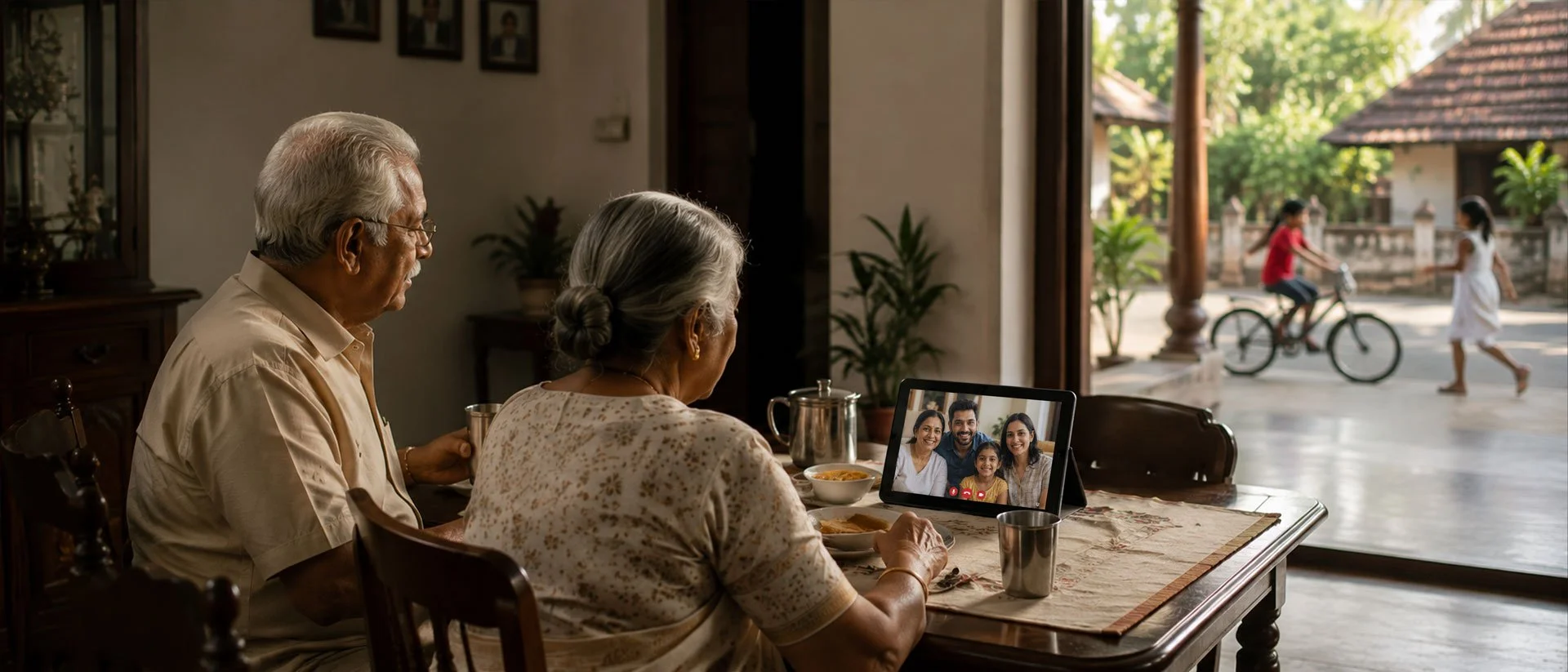
For decades, migration to the Gulf took adult children to the Middle East and left elderly parents in houses that looked prosperous but were missing the people who would normally provide care. That pattern has now shifted into something harder. A growing number of Kerala's younger professionals are moving to Western countries, Europe, North America, and Australia. Unlike Gulf workers, who typically returned after their contracts ended, many of these migrants will settle permanently abroad. They have the option of citizenship there, and most will take it. There is also substantial movement to other Indian states. What all of this leaves behind is an elderly population facing a more permanent kind of absence.
Loneliness is one of the main consequences of this. And alongside it sits a caregiving crisis that rarely gets named directly. Women, mostly daughters and daughters-in-law, are absorbing enormous amounts of unpaid care work with no training, no backup, and no recognition. Families are managing dementia with no guidance. Elderly widows in coastal and tribal communities face a particular kind of isolation that medicine alone cannot reach.
LASI data shows that in Kerala, women at 60 have a life expectancy of 22 more years, four years more than men of the same age, which means the burden of care, and the experience of being cared for, falls disproportionately on women at both ends of the relationship. Social work needs to name this plainly and act on it. That means training practitioners in caregiver support and family mediation, advocating for recognition of unpaid care work, designing community-based respite programmes for family caregivers, and making elderly women's specific vulnerabilities, widowhood, financial dependence, and social isolation, a central concern of any ageing strategy. Not a footnote. A starting point.
These are questions about relationships, belonging, participation, dignity, and meaning. Medicine can treat the body. It cannot rebuild a community or mediate a family argument over who gives up work to care for a parent. These are social work problems.
The 2030 Sustainable Development Goals reflect this. Ageing connects to SDG 1 on poverty, SDG 3 on health across the lifespan, SDG 10 on reducing inequality, and SDG 11 on sustainable communities. What those goals call for, and what elderly people in Kerala actually need, is not only clinical care. It is presence, connection, and someone who can navigate systems on their behalf. That is social work.
The window is open right now
Two things are happening together that create a real opportunity.
The state government has built the legal and institutional foundations for elderly welfare. At the same time, the National Education Policy (NEP) 2020 is changing the structure of undergraduate and postgraduate education across Kerala's universities. From 2024-25, Kerala universities began rolling out a four-year undergraduate programme. A BSW student can now leave after three years with a degree, or stay for a fourth year and earn an Honours qualification, including a research pathway that leads directly to PhD entry. The MSW has also changed: a student with a four-year Honours degree needs only one further year of postgraduate study, while those with a three-year BSW continue with the standard two-year MSW.
Curricula are being written right now. Rajagiri College of Social Sciences and Loyola College of Social Sciences have already launched the four-year BSW. Most institutions are still designing their syllabi. This is the moment to put ageing at the centre of social work education, not squeeze it in as an afterthought, and not wait five years until the new frameworks are locked in.
Kerala's State Curriculum Committee has recommended letting students take courses from different disciplines. This allows social work students to take electives in digital inclusion, public health, urban design, or the economics of an ageing population, without giving up their core programme. NEP has its implementation problems. But it has also opened a door. Whether social work walks through it is up to us.
Why social work and why it is currently missing this moment
We need to be honest with ourselves. Social work is better placed than any other profession to lead Kerala's response to its ageing transition. We already work with families, communities, and the ways systems fail people. We deal with emotions and relationships. We know how to work with communities rather than just deliver services to them. No other profession stands in exactly that space.
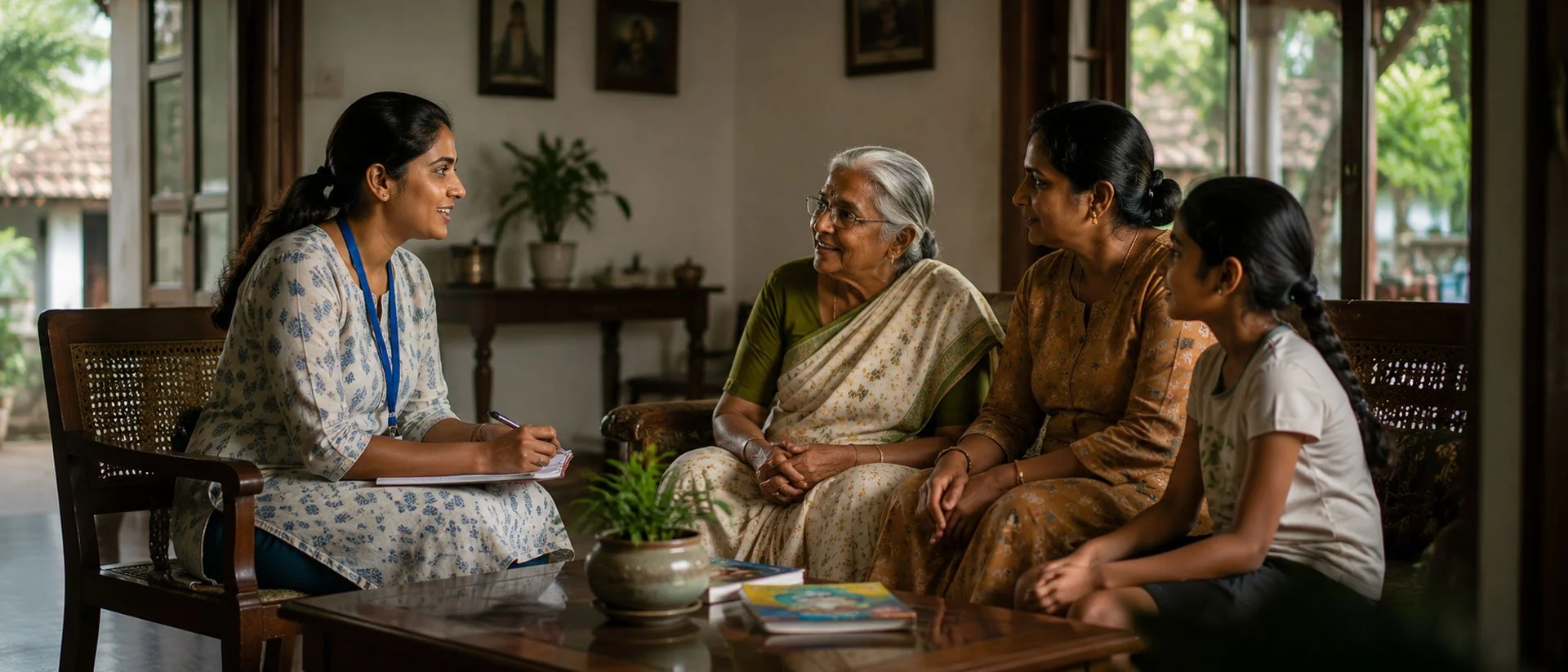
Social work begins with understanding people, families and relationships, not just services.
And yet most of what we teach students does not prepare them for this work. I say that as someone who has been inside this system for a long time.
The problems are structural. Students learn theoretical models but do not develop the ability to think across systems. Field placements are mostly short, observational, and have little to do with what ageing actually looks like over time. Students graduate without having spent real time with an elderly household, without knowing what a month of loneliness looks like from the inside, without sitting through a family argument about who gives up their job to care for a parent.
Social work education also runs in a parallel world, separate from panchayats, public health systems, and the technology platforms elderly people are now expected to use. There is almost no connection with the local government structures the 2025 Act is trying to activate.
And there is what I would call ageing-blindness. Elderly care appears as a chapter in a general curriculum, wedged between other welfare topics, with no specialisation and almost no engagement with what ageing means in Kerala specifically.
Underneath all of this is a psychological problem. Many students, and some faculty, still see elderly care as low-status work. Something you do when you cannot get a placement somewhere more prestigious. This has to change before any curriculum reform will stick. Ageing is the central social challenge for Kerala over the next 30 years. It requires skill, relational depth, and sustained commitment. That is serious professional practice.
One more thing to be transparent about: reliable data on Kerala's social work education system is thin. At least 31 institutions offer MSW programmes. The first MSW in the state was at Rajagiri School of Social Work in 1961, and Loyola College under Kerala University followed in 1964. Beyond that, there is no usable aggregate data on total BSW colleges, graduate numbers, or how many faculty have any background in gerontology. That gap is itself a problem, and mapping the sector should probably be the profession's first collective project.
What needs to change and how
Curriculum.
Ageing needs to be a core subject, not an opt-out. Every social work student should study the sociology and psychology of ageing, loneliness and social isolation, dementia and what it does to families, the situation of elderly people whose children have moved abroad or to other states, the vulnerabilities of elderly women in tribal and coastal communities, caregiving systems, grief, end-of-life dignity, and intergenerational relationships. These are the daily realities of elderly life in Kerala, not specialist topics for a minority of students.
New course areas should include digital ageing and cyber safety, family mediation in later life, ageing and technology, and social enterprise around the silver economy. The fourth year of the Honours BSW and the one-year MSW pathway are natural spaces for a proper geriatric social work specialisation.
Fieldwork.
Every MSW student should complete at least one semester of placement specifically with elderly populations. Not just in institutional settings, but in community programmes, day care centres, home visit programmes, and panchayat services. Panchayats have statutory responsibilities under the 2025 Act and are natural placement partners. Beyond that, we should move toward longitudinal immersion, where students follow a small number of elderly households for a year or more, watching what actually changes over time: health, mood, family relationships, finances, and independence. This produces practitioners who understand ageing as a human experience to be accompanied, not a condition to be managed. For this to work rather than become exploitative, each placement needs a named supervisor, regular faculty check-ins, a structured learning log, and clear boundaries that distinguish student learning from unpaid service delivery.
The care navigator role.
In the UK and Ireland, social workers embedded in community health teams act as navigators: conducting social needs assessments, connecting elderly individuals to health services, legal aid, housing support, and family mediation, and serving as a single, accountable point of contact. The role is distinct from both a medical function and a welfare officer role. Kerala has nothing comparable today. The Department of Senior Citizens Welfare should formally create it. The design question of whether a care navigator sits within the panchayat welfare structure or alongside it needs careful work, but that is a design challenge, not a reason to delay. Of all the changes possible right now, this probably has the most immediate practical impact.
Colleges as community institutions.
A social work college can be more than a place that runs a syllabus. In its district, it can serve as a resource centre for elderly people and their families, a testing ground for new community models, a research base for longitudinal ageing studies, and a training centre for caregivers, panchayat workers, and family members. Rajagiri, Loyola, and a few others already do some of this. It needs to become standard, not exceptional.
A bigger ambition: the Kerala Institute for Healthy Ageing and Longevity (KIHAL)
The Department of Senior Citizens Welfare needs an intellectual core. A place that does policy research, supports workforce development, tests community models, and maintains connections with countries further along this demographic path, Japan, Finland, and Singapore. Kerala has the academic capacity to build this. It needs organisational will, not a blank cheque.
KAPS has already recommended something along these lines in its petition to the government, calling for a Kerala Institute of Gerontology and Elder Care Management for research, training, and policy development. That recommendation deserves serious attention from universities and the state government.
Kerala could also be the first Indian state to establish Ageing Society Studies as a distinct academic field, bringing together public health, sociology, social work, urban design, technology, economics, and ethics. Approaches like the WHO's Integrated Care for Older People framework point in this direction, placing multidisciplinary and community-centred responses ahead of clinical care as the primary frame.
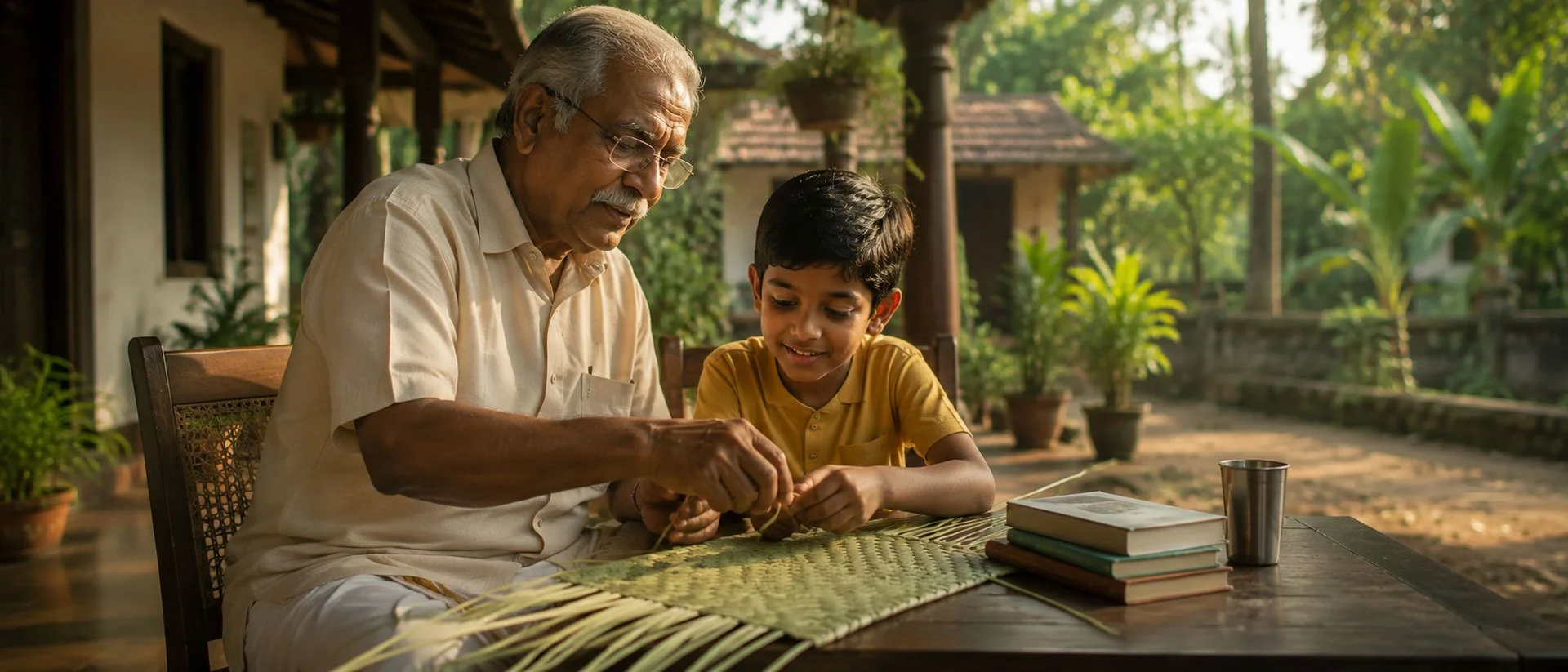
Ageing is not only about care. It is about ensuring older adults continue to contribute, teach, participate and belong.
The goal worth working toward: no elderly person in Kerala remains invisible; loneliness is treated as a public concern rather than a private problem; communities take an active part in care; and social workers are understood as people who build and repair human connections. That is not a welfare programme. It is a different kind of society.
KAPS and the case for professional organisation
Reform at this scale needs an organised professional voice. The Kerala Association of Professional Social Workers, KAPS, is the registered body trying to build that voice.
KAPS is currently doing what the profession has not done loudly enough before: putting elderly care directly on the government's agenda. Through a formal petition to the Chief Minister, KAPS is asking the government to move well beyond the current framework toward a comprehensive, community-based, rights-based system of elder care, with professional social workers placed at the centre of service delivery and protection. These are not small asks. They are structural changes.
Whether or not every recommendation gets taken up, this kind of specific, organised advocacy puts social work on record as a profession with a clear position. Colleagues who have not yet engaged with KAPS should consider doing so. The profession will carry more weight if more of us are working together.
The obstacles are real
Social work has lower institutional status than medicine or law. That limits funding, limits faculty development, and limits who gets heard in policy discussions. Many faculty members have not had the chance to engage with ageing innovation, emerging technology, or systems thinking of the kind this moment requires. Resource constraints are particularly acute in smaller affiliated colleges.
NEP implementation is also a genuine risk. Early evidence from other states shows the four-year structure has sometimes produced curriculum overload and weaker outcomes when institutions lacked the capacity to deliver it well. Kerala needs to design the ageing specialisation carefully, not rush it through to satisfy an administrative deadline.
Emotional sustainability matters too. Working alongside elderly people, with grief and family conflict and slow decline, takes a toll. Students and practitioners need proper supervision and peer support, not just technical training.
Priorities for the next five years
If the profession is going to respond to this moment, a few things matter more than others. These are not a checklist. They are a starting point for the kind of honest conversation the profession needs to have with itself.
First, a sustained statewide conversation about what an ageing society actually means for social work in Kerala. Not a conference theme. A real discussion, led by KAPS and the Association of Schools of Social Work in Kerala together, about what we are being asked to do and whether current education and practice are fit for that purpose.
Second, a much clearer picture of our own sector. How many BSW and MSW institutions are there? What do graduates do after they finish? How many faculty have any background in ageing? This data does not exist in usable form. Without it, we are arguing for reform based on impressions.
Third, ageing must move from the margins to the centre of social work education. Not as an elective, not as a single semester, but as a thread running through curriculum, fieldwork, and research across all programmes. The FYUGP redesign is happening now. If we do not act in the next year or two, the structure will be set and another decade will pass.
Curriculum reform without faculty development is an empty promise. Most social work faculty in Kerala have had little exposure to gerontology, ageing technology, or the kind of systems thinking this curriculum requires. Upskilling existing faculty needs to run alongside any new curriculum, not follow it. Bringing in practitioners as guest faculty while permanent staff are being developed, creating faculty exchange arrangements with institutions that already have gerontology depth, and using the proposed KIHAL as a faculty development hub rather than only a research institution are all practical starting points. Realistically, embedding genuine gerontological competency across a faculty cohort takes three to five years. That clock needs to start now.
Fourth, social work colleges need to build serious, sustained partnerships with panchayats, community organisations, and the new district structures under the elderly welfare framework. Individual relationships exist in some places. They need to become institutional and not dependent on a particular faculty member or principal.
Fifth, advocate clearly for the formal creation of the care navigator role within the Department of Senior Citizens Welfare. This is not a vague policy. It is a specific employment structure that would give social work graduates a professional home in the state's elderly care system and provide elderly people with a trained, accountable point of contact.
There is also a sixth area the profession has tended to ignore. Not all elderly care innovation will come from the government. Social workers with entrepreneurial inclinations can build practices around family mediation, caregiver coaching, community programme design, and longevity planning. The silver economy is growing, and social enterprise in this space can generate both income and impact. Social work education should stop treating private practice and social enterprise as somehow less legitimate than institutional work.
None of this is easy. But none of it is out of reach. Kerala has the institutions, the community connections, and a government that has signalled it wants to act. What the profession needs now is the honesty to admit it is not yet equipped, and the commitment to get there.
The conversation needs to happen now
We have 60 years of social work education in Kerala. We have community relationships. We have the panchayat system working on elderly care as a potential partner. And we have KAPS making the case, publicly and specifically, that social work belongs at the centre of this response.
The ageing transition is a version of what Kerala has navigated before, when it built public health infrastructure, when it ran literacy campaigns, and when it turned panchayats into working institutions. Those transitions required the same things this one does: sustained professional commitment, honest self-assessment, and willingness to change.
What we need is the professional honesty to look at what we are currently producing and ask whether it is adequate for what Kerala actually faces. My honest answer is no. And I think most of us already know it.
The conversation needs to happen now, in our colleges, in our professional associations, and with the government bodies just created to take this forward.