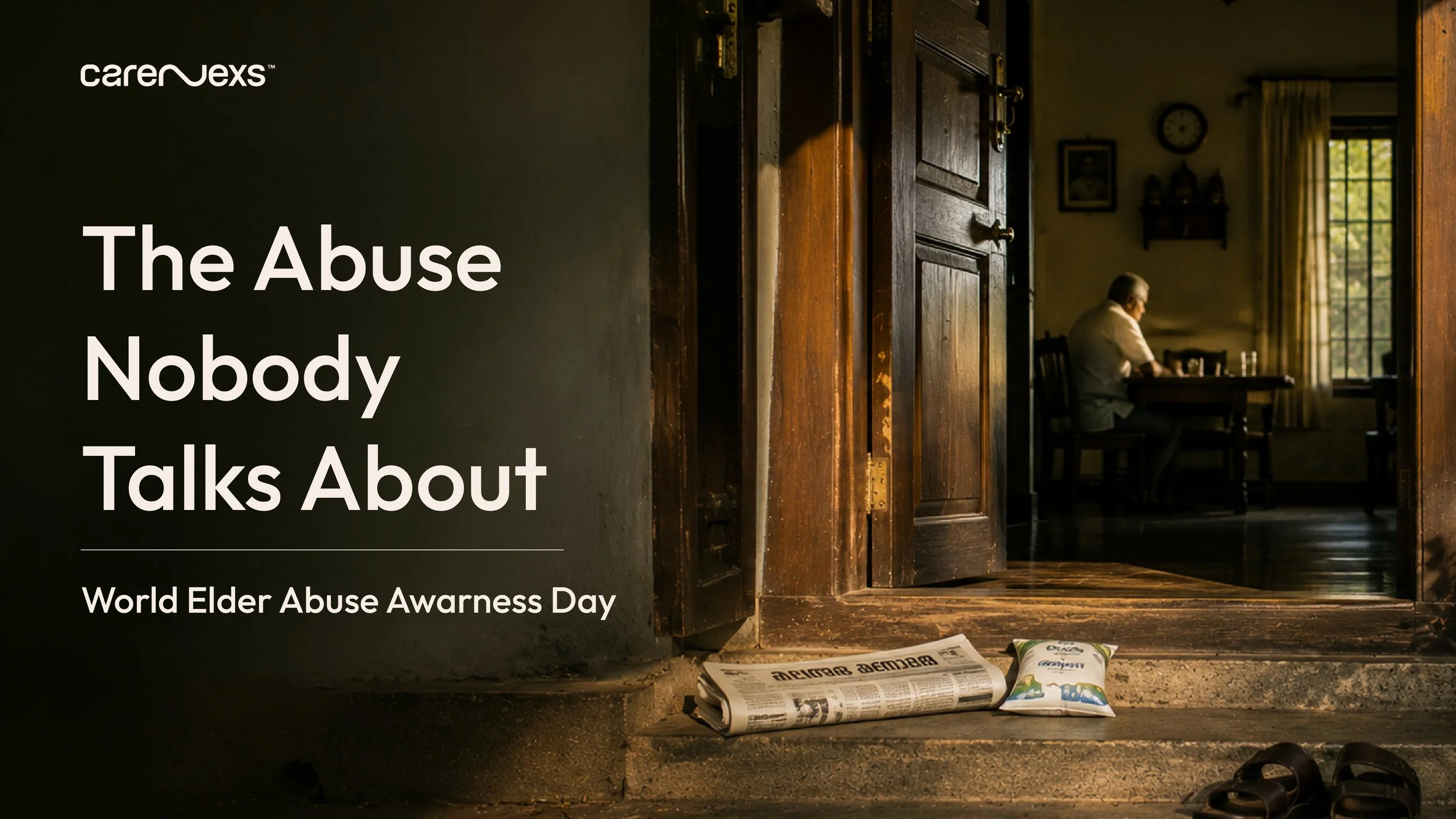
The Abuse NobodyTalks About
World Elder Abuse Awareness Day
Today is World Elder Abuse Awareness Day. And I want to talk about the kind of abuse that never shows up in a police report, never leads to protection orders, and often doesn’t look like abuse at all.
It can look just like an ordinary Tuesday afternoon.
Let me describe someone I want you to picture
He is 74. Retired government servant. His house is clean and well-maintained. His son is in Toronto. His daughter is in Bangalore. Both call on Sundays. Both send money. Both believe without a doubt that their father is fine.
He has food. He has a television. He has his pension.
What he does not have is someone to eat with.
He has not sat at a table with another person for eleven days. He manages six medications on his own, and last week, he took the evening dose in the morning because the tablets look similar and he was not paying attention. His knee has been painful for three months, but he has not told anyone because he does not want to worry his children. Getting to the clinic involves a three-wheeler ride that has become harder since his balance started going, and he keeps telling himself he will go next week.
He stopped going to the temple last month. Not because of faith. Because the steps are difficult now, and he is embarrassed to ask for help.
He is not being abused.
Nobody would say he is being abused. He would not say it himself. But something real is being taken from him every single day. There is no one who will wonder where he is if he does not come. No one is counting on him to walk through the door. No one is asking how he is; they are actually waiting to hear the answer.
This is not happening because anyone is cruel. His family loves him, is far away, and trusts that distance plus money equals care. The community around him has slowly reorganised itself around working-age people, and nobody rebuilt it to include him. And so he lives in a house that is full of everything except presence.
We have been looking at the wrong picture
On World Elder Abuse Awareness Day, we usually focus on what we can see. Physical violence. Financial exploitation, or Families who leave completely. These are real and serious problems and deserve all the attention they get.
But there is a different kind of harm that our frameworks are not equipped to see. There is no perpetrator. There is nothing to record. It’s a condition, not an incident. A slow daily erosion of what a full human life looks like.
The WHO definition of elder abuse includes neglect, not just acts of commission but acts of omission as well. But in practice, neglect still tends to mean something visible. Someone who refused to help. A family that abandoned a person entirely.
What we have not yet named is this: a society that reorganised itself entirely around people who are mobile, digitally connected, and working, and never rebuilt itself to include those who are older, slower, and more dependent on proximity and being known.
That reorganisation was not malicious. But its effects on elderly people are real. And because it has no face, no perpetrator, no single act to point to, it falls outside our abuse frameworks entirely.
I think we need to change that.
The numbers tell part of the story
The Longitudinal Ageing Study in India, the largest survey of older adults this country has conducted, found that more than half of Kerala's elderly aged 60 and above are managing two or more serious chronic conditions simultaneously. Fifty-seven percent have cardiovascular disease, the highest rate of any Indian state. Around 30 percent of elderly women in Kerala show symptoms of depression.
Kerala has the longest life expectancy in India. That is worth celebrating. But it also means more people living longer with more illness, and the question of who is with them, who knows them, who notices when something changes, that question is not answered by a life expectancy figure.
How many of that 30 percent of elderly women with depressive symptoms are known to any professional? How many are managing their depression the way the man in our story is managing his knee pain? Quietly. Alone. Not wanting to be a burden.
Depression in an elderly person living alone is not just a clinical matter. It is a signal. We give it a clinical name when it reaches a certain severity. But before it got that name, it was just too many days without someone asking how you are and actually waiting to hear the answer. Depression is the symptom. The loneliness is what caused it.
The grief underneath
Elderly people in Kerala are grieving. Not only the loss of people they loved, though that too. They are grieving the loss of a particular way of daily life. A life that had people nearby who knew them well enough to notice if something was wrong.
That grief does not look like grief from the outside. It appears quiet. It looks like saying everything is fine on a Sunday call. It looks like someone is slowly withdrawing from things that used to be important, not because they have given up, but because the cost of participation has become too high for the return.
Social workers are trained to read underneath the presenting situation. We know that withdrawal is not peace. We know that no complaint is not the same as no problem. But that skill only works if someone is present to use it. And right now, for thousands of elderly people in Kerala, nobody is present. Not because people do not care. Because the system has not placed anyone there.
So what do we do about it
I work in a field that has the knowledge, the training, and the community relationships to respond to this. Social work already understands families, grief, systems, and what it means to be in a situation that nobody else can see clearly. No other profession sits in exactly that space.
But social work in Kerala is not yet organised around this reality. Elderly care is still a chapter in a general curriculum. Students graduate without spending real time with an elderly household. There is no systematic professional presence in the lives of people like the man in our story.
The 2025 Elderly Commission Act and the new Department of Senior Citizens Welfare are real opportunities. But institutions without trained professionals are just buildings. The missing piece is a social worker whose job is to know. To visit. To notice the knee pain before it becomes a fall. To understand the medication confusion before it becomes a crisis. In the UK and Ireland, this role is called a care navigator, which is embedded in community health teams. It is a real, remunerated position. In any organised form, there is nothing in Kerala to compare with it.
That needs to change.
A question for today
World Elder Abuse Awareness Day asks us every year to pay attention to the harm being done to elderly people. I want to suggest that, in 2026, we broaden what we pay attention to.
Not only can we see, name, and prosecute the harm. But the daily, quiet, accumulating harm that only becomes visible when someone is trained to look, positioned to look, and given the reason to look.
The man in this story does not need our awareness. He needs someone to show up. Someone who knows his name, knows his medications, knows the temple steps have become difficult, and has both the training and the mandate to do something about it.
That is what social work is for. And this is the moment to say so.
The goal worth working toward: no elderly person in Kerala remains invisible; loneliness is treated as a public concern rather than a private problem; communities take an active part in care; and social workers are understood as people who build and repair human connections. That is not a welfare programme. It is a different kind of society.